What a terrible, shitty year 2025 was. Let’s be clear, Trump’s inauguration was enough to contaminate a decade, not just a year. It was bewildering to see how quickly the masks came off, and the unapologetic shift toward fascism charged in. In New York, we responded by electing a socialist democrat mayor, Zorhan Mamdani, but my distrust of politicians remains. Does the election of a socialist mayor fall under the banner of revolution by any means necessary? But the awfulness doesn’t stop on the political level. I’ve seen loved ones suffer from homelessness and addiction. I’ve seen mental illness destroy friendships. And I’ve experienced my own hellish and expensive medical bills. This has been one of the gloomiest years I can remember. I would comment here about the deaths of Ozzy Osborne, who wrote one of my favorite songs of all time (“Fairies Wear Boots”), or of Bruce Loose of Flipper, but their deaths seem irrelevant when I hear about the deaths of actual acquaintances and friends. Less than a month ago, I learned of the death of an old Portland friend, Nigel, who was homeless and had occasionally requested money from me during his hard times.
In October, I was saddened to learn that my old writing mentor, Hal Sirowitz, passed away. I first contacted Hal when I was a teenager. I had been reading Rant magazine, a New York-based literary zine that often published Hal. I wanted to get a hold of one of Hal’s chapbooks, so I wrote to the editor of Rant, who passed on Hal’s information to me. This started an exchange of letters between Hal and me that would last for years. Hal read and critiqued my prose poems, recommending authors and artists he thought I’d like. He introduced me to René Magritte and surrealism, and also to his New York poet friends, including Sparrow, Steve Dalachinsky, Joe Maynard, and Ron Kolm. I wrote to them all, and it felt exciting to be connected to something so far away from me. In 1996, Hal wrote the introduction to my first chapbook, Who the Hell is Brandon Freels? I remember the excitement of seeing him read on MTV’s Spoken Word Unplugged. “I know that guy!” I told my parents. I first met him in person when he was on tour for his book, Before, During, and After. That must have been around 2003. When I visited him in Philadelphia in 2016, Parkinson’s disease had debilitated him, but he insisted on meeting me in town. The two of us explored Isaiah Zagar’s fantastic outsider piece, Magic Gardens, and later, at Hal’s home, he showed me a poem he’d written about a train conductor. It was amazing. Hal had such a way of stepping into the mind of the speaker, creating vivid, poetic internal monologues. I wish I had a copy of that poem.
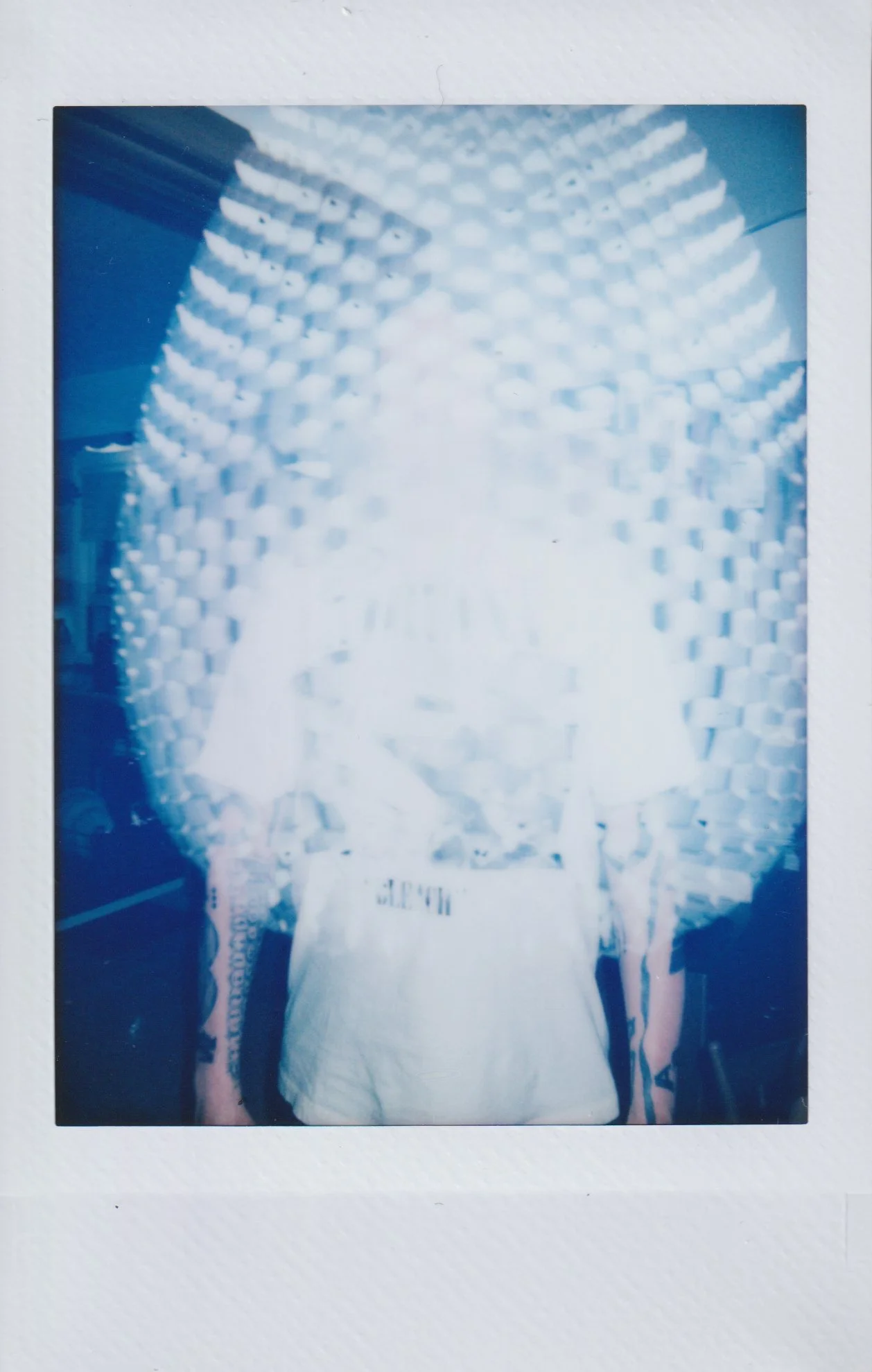
In mid-July, I flew out to Portland. I had a fairly satisfactory trip and spent most of the time catching up with old friends. As always, I stayed with Nova and tried to convince him to buy Baldur’s Gate 3, as he was the one who introduced me to the originals when we were younger. I was able to meet up with my old friends Jai, Marcella, and Toby, all people I know from the Stankhouse era of my life. I was also able to catch up with Kevin Sampsell of Future Tense Books and Mike Daily, whom I met through Kevin many years ago. Mike and I had an impromptu photo session with my Instax camera, and I quite like the results. The thought of moving back to Portland still lingers in my mind sometimes. Visiting Portland in the summer will do that to you.
While in Portland, I checked out the hardcore band Dry Socket. At one point, the singer of Dry Socket yelled, “Circle pit!” On cue, all the kids started circle-pitting. I enjoyed that atmosphere much more than the weird kung fu dancing that had been going on previously. I went up to Olympia the next day and was able to catch Dry Socket again at a place called Lamplighters. I was in Olympia to find an ex-partner of mine, but was unable to. She sent me a message that she was homeless and addicted to fentanyl, and that I wouldn’t want to see her right now. That evening, while in my crappy hotel room, I noticed some fireworks going off down by Capital Lake. It turned out there was a fair happening. They had one of those old-time photobooths, and I saw all the bands that played earlier having their picture taken as cowboys. I would love to have a picture like that taken with friends. I wandered through the fairground and was hoping there was a freak show or something, but there wasn’t. I thought about my ex. She and I would have had a great time together at the fair. I imagined a parallel universe where we went there together and had our pictures taken together in cowboy hats.
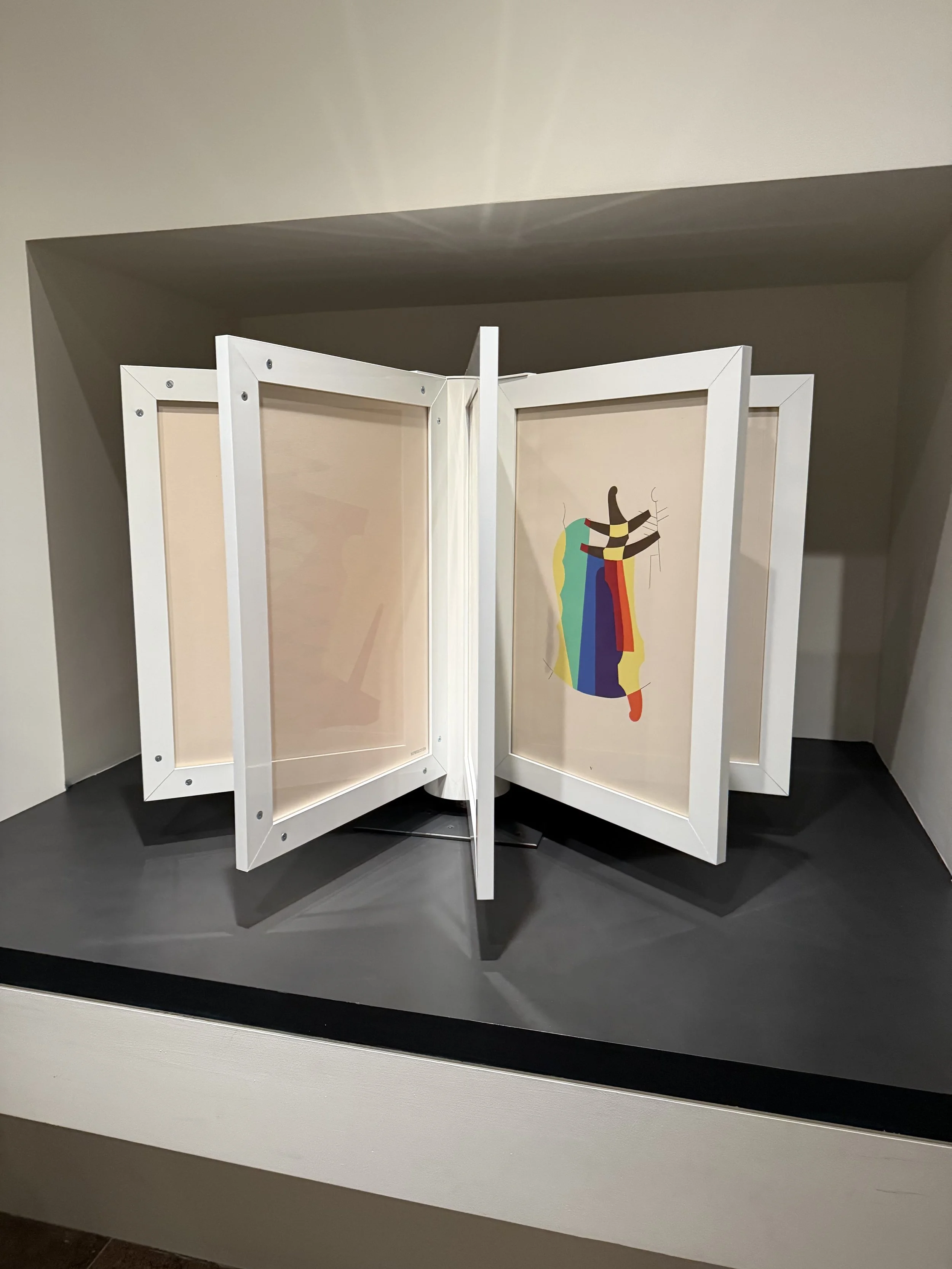
Last year was the 100th anniversary of the Surrealist Movement, and New York is finally catching up. The MET had a Man Ray show based around his rayograms. I’ve never seen so many rayograms in one place. There were hundreds in the central rooms, while the surrounding rooms explored the other aspects of his career. There were some very Dada paintings he’d done, similar to Francis Picabia’s style. Many had geometrical shapes and forms, like his famous The Rope Dancer Accompanies Herself With Her Shadows, which is easy to mistake for a Duchamp. Man Ray also created a series of abstract color collages that were placed on ballbearings, allowing the viewer to spin the collages around. He called this work Revolving Doors. For the era, this kind of inventiveness would be unheard of in the art world. Who, back then, would call this art? Also included were some playful aerographs, created by experimenting with an airbrush, including one that mimicked a Braque cubist painting. Man Ray seems very good at mimicry, but he’s also keen on following new paths. Like Duchamp, he worked with glass panels and pieces that had two-sided frames. They had some of his surrealist objects in the collection and also displayed items he used in photos to create the strangeness in his rayograms.
MoMA added to the surrealist celebration with a mind-blowing Wilfredo Lam exhibit. I didn’t know much about Lam beforehand, and saw him as an understudy of Picasso’s, but Lam’s body of work was much broader and more fascinating than that. The works felt lived-in, as if they had a physical presence to them. They felt like you could walk inside of them. I didn’t expect that. His piece The Jungle is thick with bodies and limbs, and the jungle is both plant and flesh. There are little faces scattered throughout his works, as if the paintings are haunted by secret gnomes. Can the subjects of the painting see these creatures, or am I the only one? It’s hard to tell the difference between leaves and wings, and there’s a recurring little guy in a bowl. I imagine that’s the artist putting himself in the works as a passive observer. Breasts are in abundance, but are they human breasts or udders? Limbs that could both be arms or entire beings droop off larger figures, while other limbs stand up taut and erect. Some of his works appear to be formal portraits, but with the uncolonized eye, the clouds part and the world of the marvelous is revealed.
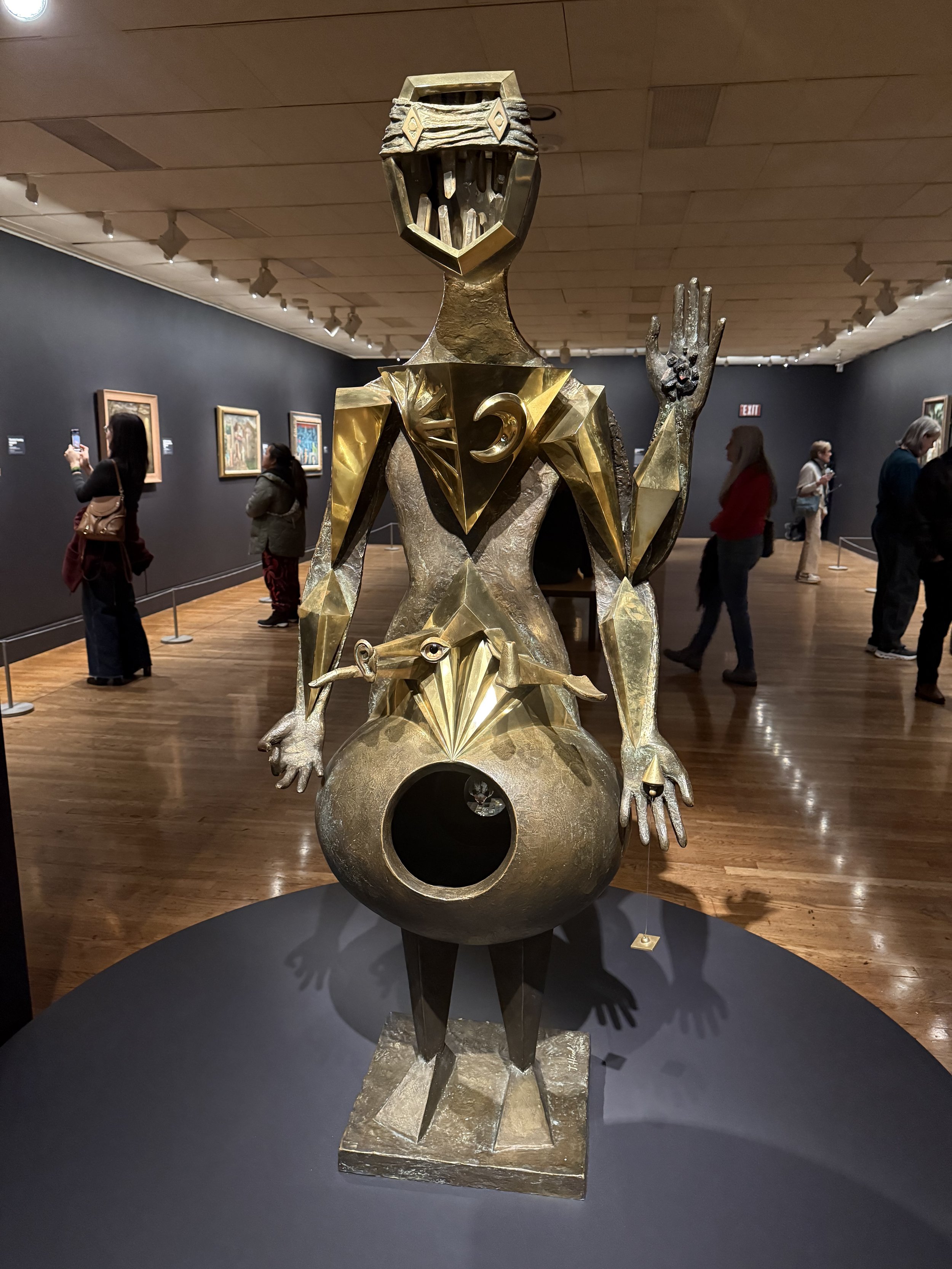
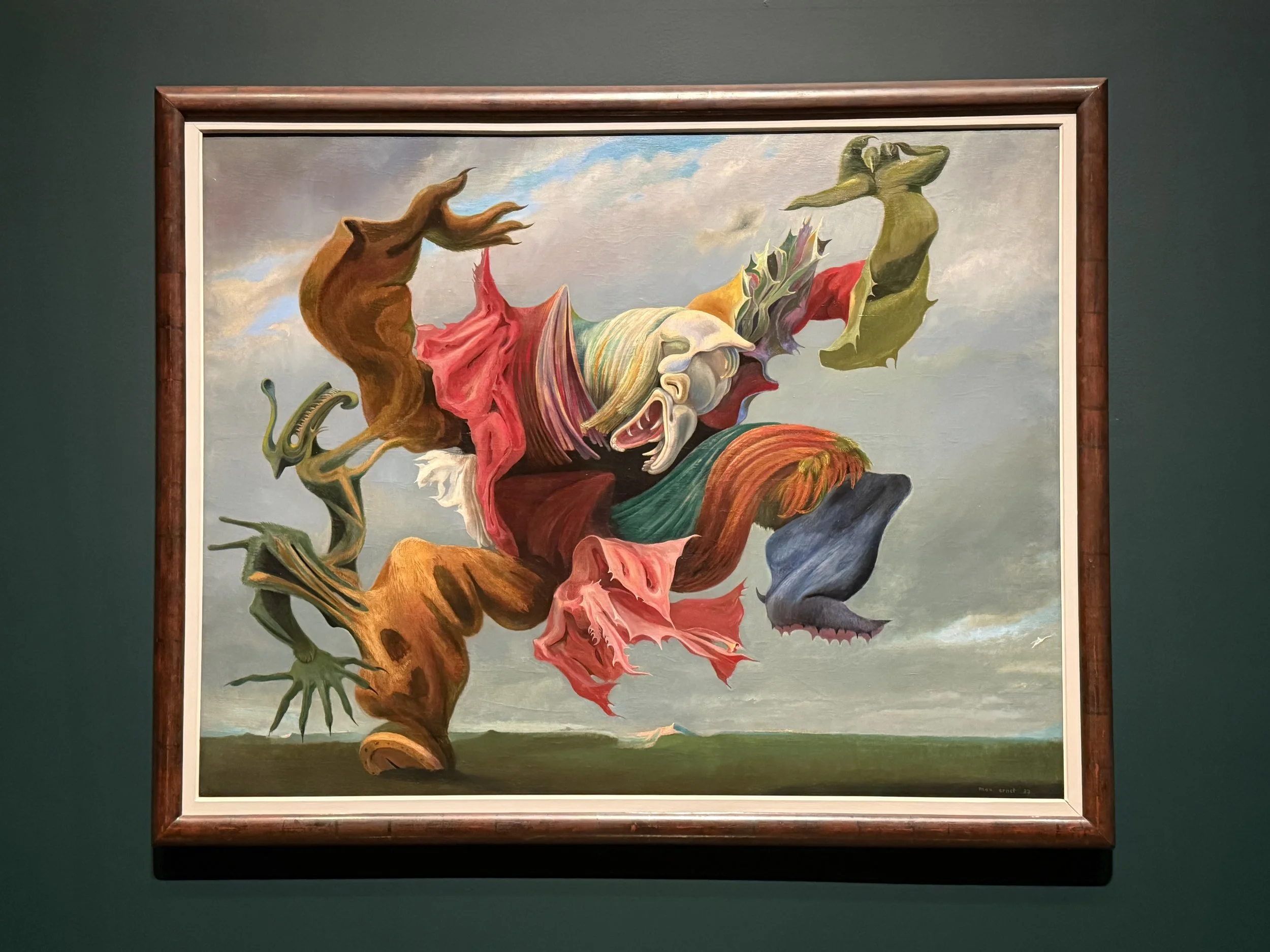
In early December, I took the Acela train to see the Dream World: Surrealism at 100 show at the Philadelphia Museum of Art. There were some incredible works there, my favorite being Jacques Hérold’s sculpture The Great Invisible One, which was new to me, and sent a jolt down my spine. I’m a sucker for a good sculpture. In my head, I couldn’t help seeing this work as a good counterpart to Giacometti’s Hands Holding the Void (Invisible Object). Two other works I really enjoyed were by Max Ernst, and they, too, seemed to complement each other. The first was Chimera, which was then followed by The Triumph of Surrealism, a piece known for gracing the cover of the English version of Breton’s Surrealism and Painting. Chimera is another work that’s new to me. Here, Ernst is playing with the dancing bird form as it appears to be morphing together with a female human torso and the headstock of a musical instrument. When comparing these two works, I can’t help but see them, made fifty years apart, as part of the same evolutionary path. It was an enjoyable show, but personally, I was put off by the inclusion of Calder and Klee. I was less put off by the inclusion of surrealist-influenced works by Pollock and Rothko, but felt these inclusions could confuse someone new to surrealism. There were also some names I didn’t recognize, and I wondered if they were surrealists I was unaware of, or artists the critics and curators wanted to sell as surrealists.
Hauser & Wirth had a fantastic Picabia show that explored his later works, featuring many biomorphic forms and abstract images. Picabia considered this a third path between surrealism and abstraction, but I see them as an expansion of his Dada style into abstract forms. I often wondered: what was he sitting in front of while painting? Objects in a clear plastic bag? Some aquatic aliens trapped in an ephemeral prison? Many of Picabia’s late works really minimize the form and shape. The Di Donna Gallery had both a Dali show and a Magritte show. In the Dali show, he basically took reprints of old masters and painted on them. These were all made for Dali’s book Wines of Gala. The cover is my favorite piece as it shows a multitude of Galas. The Magritte show at Di Donna was a joint show with Les Lelanne. The Magritte works were interesting, but not outstanding. Many of the works were his see-through style. Les LeLanne had some curious works, like a hippopotamus-shaped bathtub.
Printed Matter’s Art Book Fair was in September, and it was hot as hell at MoMA PS1. What a shame that such a fascinating collection of books and zines was ruined by the evilist of heat. I was able to wander through PS1, getting away from the crowds, and came across a memorable metal flower that opened and closed hydraulically. It reminded me of something out of the video game Horizon Zero Dawn. In the basement of the building, I came across a collection of work by the Detroit Printing Co-op, which printed the first English translation of The Society of the Spectacle. They also printed The Reproduction of Everyday Life, The Wandering of Humanity, and many Fredy Perlman projects, plus copies of Radical America. It’s fascinating to see books and pamphlets I own under glass.
In October, with my friends Jaz and Ripley, I went on a small gallery run. We traversed Lower Manhattan through a multitude of galleries and found our way into a gallery I was not familiar with. The show was for Geumhyung Jeong’s robots. These were weird part-vehicle, part-mannequin objects. They looked as if they were motorized, with their thick go-cart wheels, but they couldn’t function in any way. Some of them had plastic human genitalia and guts, or arms sticking out of their wheels. We finished the run with the Ted Joans show at the Zürcher Gallery. These were collages and drawings based on The Statue of Liberty. I spoke with the curator, telling her I had met Laura Corsiglia, Ted’s lover before his death, many years ago, when I was a member of the Portland Surrealist Group. I wonder if Ted’s sexualization of The Statue of Liberty in some of the collages was related to Duchamp’s, as seen in his work Étant donnés. Some time later, on my own, I stumbled my way to the Levy Gorvy Dayan Gallery, where they had an 80s show, featuring Warhol, Basquiat, Barbara Kruger, Keith Haring, Mapplethorpe, Richard Prince, Piss Christ, and more. This show was rather unremarkable, and I wouldn’t even comment about it if I wasn’t moved by Francesco Clemente's piece Name. It showed a man’s face, and inside his ears, nose, eyes, and mouth are little heads and faces peaking out. For some reason, this fascinating painting made my skin crawl.
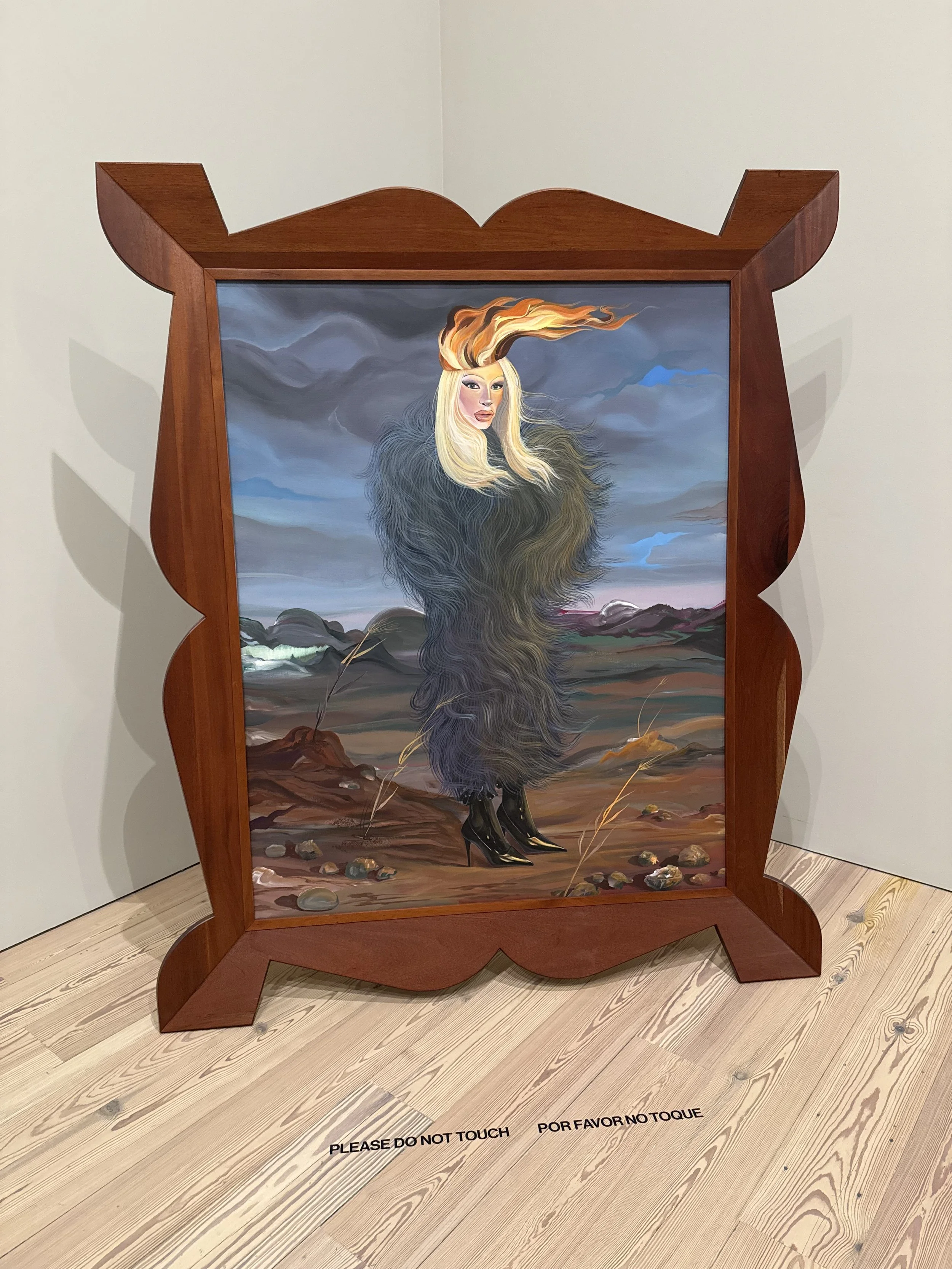
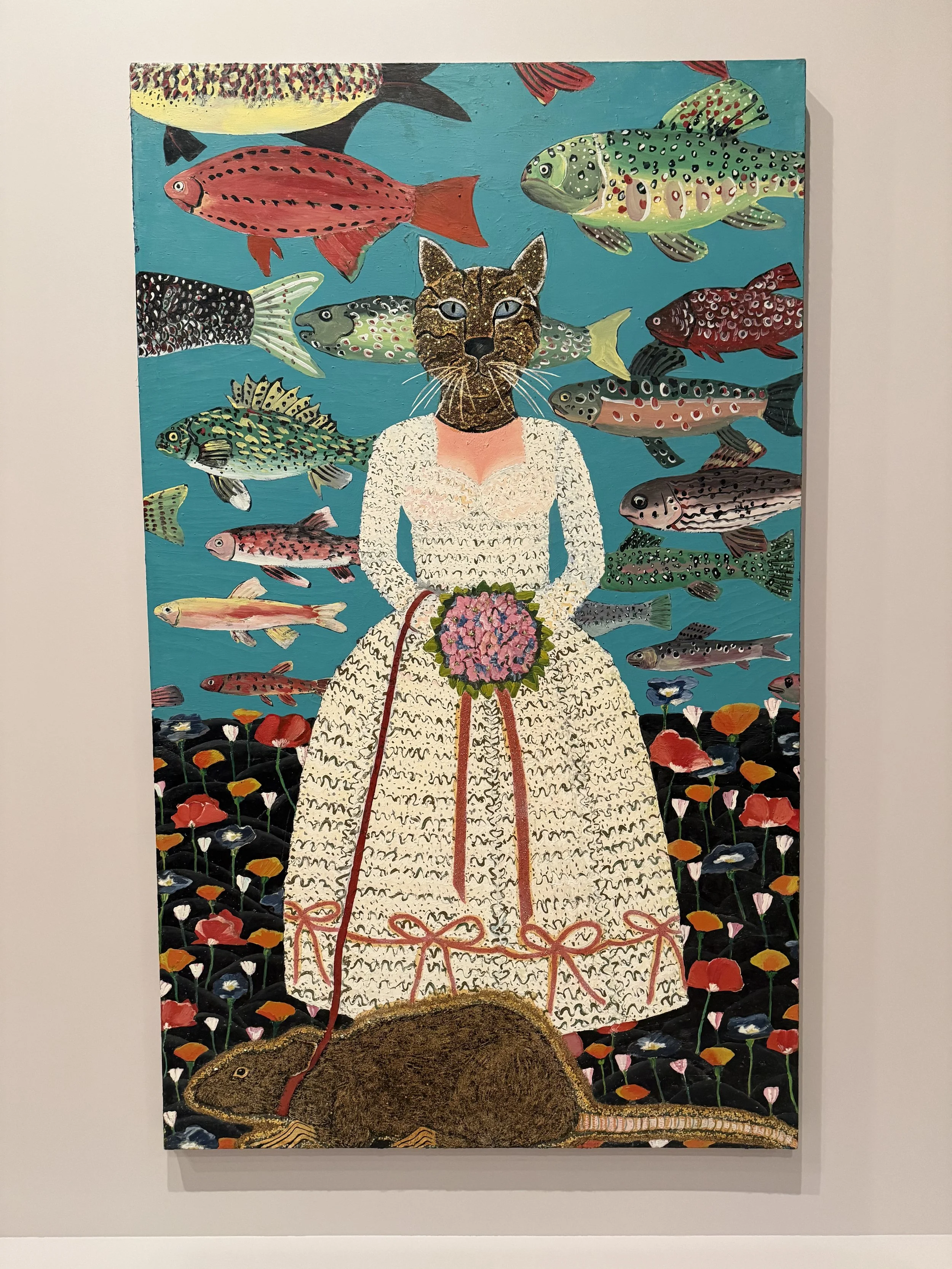
Lastly, I made my way to the Whitney for one of their Free Fridays. I went straight to the top of the building and found Calder’s miniature circus spread out over a giant room. Moving through the next two galleries, I came across a striking piece by Dalton Gata called I Don’t Need You To Be Warm. The picture was the first thing I saw that excited me. In it, a woman or drag queen in a fur coat and boots stands in some kind of windswept wasteland, with dark clouds and a rocky terrain behind her. Honestly, I was skeptical about visiting the Sixties Surreal show at the Whitney because I felt it would misrepresent surrealism. This is one of the reasons I went on a Free Friday. I needed to see the show for myself, but didn’t think I’d want to pay for it. The first thing I noticed was a colorful piece by Raymond Saunders, with its striking red abstraction that commands the image. Barbara Chase-Riboud’s Confessions for Myself also stood out like some dominating Darth Vader figure, or black gown meant to be worn by some otherworldly shaman. Other things I liked were the collage prints by Romare Bearden and photos by Luis Jimenez. Judith Bernstein’s Vietnam Garden was funny, but underneath it all was a darkness about war. In another room, I found a fantastic piece by Joan Brown, a cat-headed woman in a wedding gown, surrounded by fish floating in the sky! Later, I saw paintings by Karl Wirsum and Robert Smithson (yes, the Spiral Jetty guy) that impressed me. Curiously enough, there wasn’t much mention of Fluxus or Neo-Dada in this exhibit. I felt it did a decent job of showing how surrealist interests spread throughout the underground and art world, influencing many artists who may not have been aware of surrealism as a living movement.
I’ve been slowing down when it comes to punk and noise shows. I’m feeling exhausted in general. I did finally make it out to Far Rockaway for a noise show at the legendary Red Light District. And, in August, I got to see L.O.T.I.O.N. and Dollhouse at Tompkins Square for an intense and fun summer show. I was joined briefly by surrealist Wayne Kral, who frequents Tompkins. This might have been my favorite L.O.T.I.O.N. show. At some point, a musclebound Mr. T look-a-like ran in circles in the pit with a purple smoke bomb, and it made for a beautiful sight, as the kids in dirty punk clothes kicked and swung their fists in the air, and mashed into one another. I saw my friend Derek in the pit, kicking their feet and stomping like they just learned how to lift their legs. They were covered with sweat and just letting it go, and that’s kind of what I think the pits are all about, letting your body do the thinking. The second outdoor show I went to happened the day after Charlie Kirk was shot. Haram and Blue Anxxiety headlined, and during Blu Anxxiety’s set, the vocalist came out dressed as an I.C.E. cop, but it was spelled L.I.C.E. instead.
Speaking of I.C.E., as I’m writing this, the government is claiming the murder of Renee Good in Minneapolis by I.C.E. agents was justified. All one has to do is watch the video to know they are lying. I.C.E. is no longer about immigration, and maybe never was. They are a confirmed anti-civilian force. If it’s not blatantly obvious, the right wing wants us all dead. If you are a leftist, they want you dead. If you are a socialist, they want you dead. If you are queer, they want you dead. If you are a person of color, they want you dead. If you are anti-capitalist, they want you dead. If you are a liberal, they want you dead. If you are handicapped, they want you dead. If you are homeless, they want you dead. If you are the wrong religion, they want you dead. If you didn’t vote for Trump, they want you dead. If you protest, they want you dead. If you are working class, they want you dead. If you are anti-fascist, they want you dead. In their minds, human life that doesn’t serve capital is disposable. How close are we to a totalitarian government? Earlier today, I tried to share a post on Instagram of David Bowie’s video for “I’m Afraid of Americans.” Instagram blocked it. This is the world we live in. The United States no longer exists. Here’s to a shittier 2026! Stay safe.
What I’ve been watching:
Weapons (Zach Cregger, 2025)
It Ends (Alexander Ullom, 2025)
Punishment Park (Peter Watkins, 1971)
Mister Designer (Oleg Teptsov, 1987)
The Long Walk (Francis Lawrence, 2025)
What I’ve been listening to on the subway:
Get Hustle - Down From the Clouds (Out Louds)
The Misfits - Earth A.D.
Bad Brains - Black Dots
America - America
The Wipers - Is This Real?
What I’ve been reading:
Jennifer L. Shaw - Exist Elsewhere: the Life and Works of Claude Cahun
Shane Kowalski - Are People Out There
Evan Nicholls - Easy Tiger
Yoko Ono - Grapefruit
Vítězslav Nezval - A Prague Flaneur